

The new production machine has just arrived at your factory. It weighs 8 tons. It is large. And it must be moved from the container parked outside, through the warehouse door which has a tight fit, and then positioned with precision at the predetermined spot on the production floor—between other machines already standing to its right and left.
For some, this scenario sounds simple. For production and logistics managers who have experienced it, this is an operation that requires planning, the right tools, and an experienced team.
One of the tools? The machine falls, breaks down, or even damages the surrounding factory infrastructure. Not enough tools? The work cannot be completed, the production line halts, and losses keep mounting every hour.
This article guides you to understand the most suitable heavy equipment for each stage factory machine rigging process — from loading and unloading at the receiving area to final setting on the production floor — as well as when each tool is the best choice.
Why Factory Machine Lifting Is Not a Job to Be Taken Lightly
Unlike lifting construction materials such as concrete or steel, production machinery has characteristics that make handling them much more challenging:
💰 Extremely High Asset Value
Modern production machinery can cost hundreds of millions to billions of rupiah per unit. Damage caused by improper handling—even seemingly minor damage—can result in significant losses, void the manufacturer’s warranty, or require costly component replacements.
⚖️ Extreme Weight But Unevenly Distributed
Many industrial machines have very large weights — from several tons to tens of tons — but their weight distribution is uneven. Incorrectly determining the lifting point (center of gravity) can cause the machine to tilt when lifted, which can lead to serious damage or dangerous situations.
📐 Non-Standard Dimensions
Production machinery comes in various shapes and sizes that are often not “easy” to move: disproportionate lengths, widths, and heights; protrusions on various sides; or protruding components that can easily get caught or damaged.
🏭 A Restricted Work Environment
Inside the factory, there is very little room to maneuver. There are other machines to the right and left, cables and pipes above and below, a floor that must be protected from damage, and doorways that are often only slightly larger than the machine itself.
🔌 Shock Sensitivity
Many precision machines—CNC machines, industrial electronic equipment, measuring instruments—are highly sensitive to shocks, vibrations, or excessive tilting. Improper handling can damage internal components that are not visible from the outside.
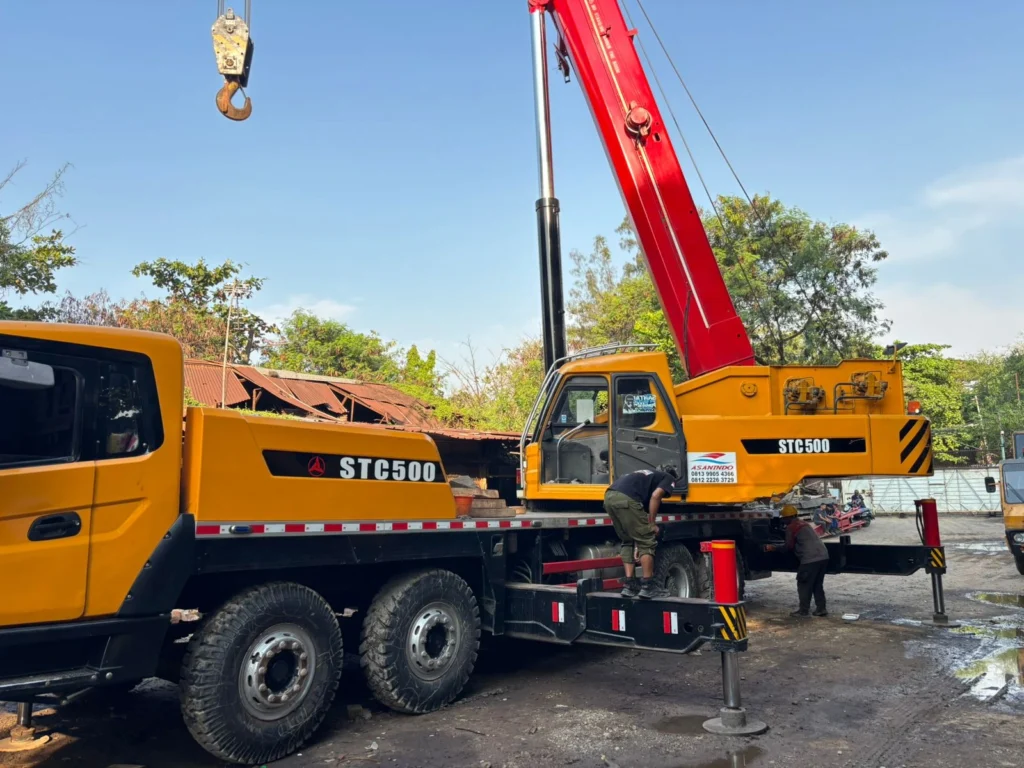
The Three Main Stages of Lifting a Machine: Each Stage Requires Different Tools
Understanding the right heavy equipment cannot be separated from understanding that the factory machine lifting process generally consists of three main stages each of which has different challenges and tool requirements:
Stage 1: Unloading from containers or transport vehicles Stage 2: Internal transportation from the receiving area to the installation site Step 3: Final setting and positioning at the precise installation point
Let's discuss the right tools for each stage:
Step 1: Unload the Engine from the Container or Vehicle — A Mobile Crane Is the Solution
When the machinery arrives in a container (whether a 20-foot, 40-foot, or flat rack container) or on a flatbed truck, the first step is to unload it from the transport vehicle and move it to the receiving area or directly into the factory.
Why is a mobile crane the best piece of equipment for this stage?
✅ Mobile Cranes Can Reach Inside Containers
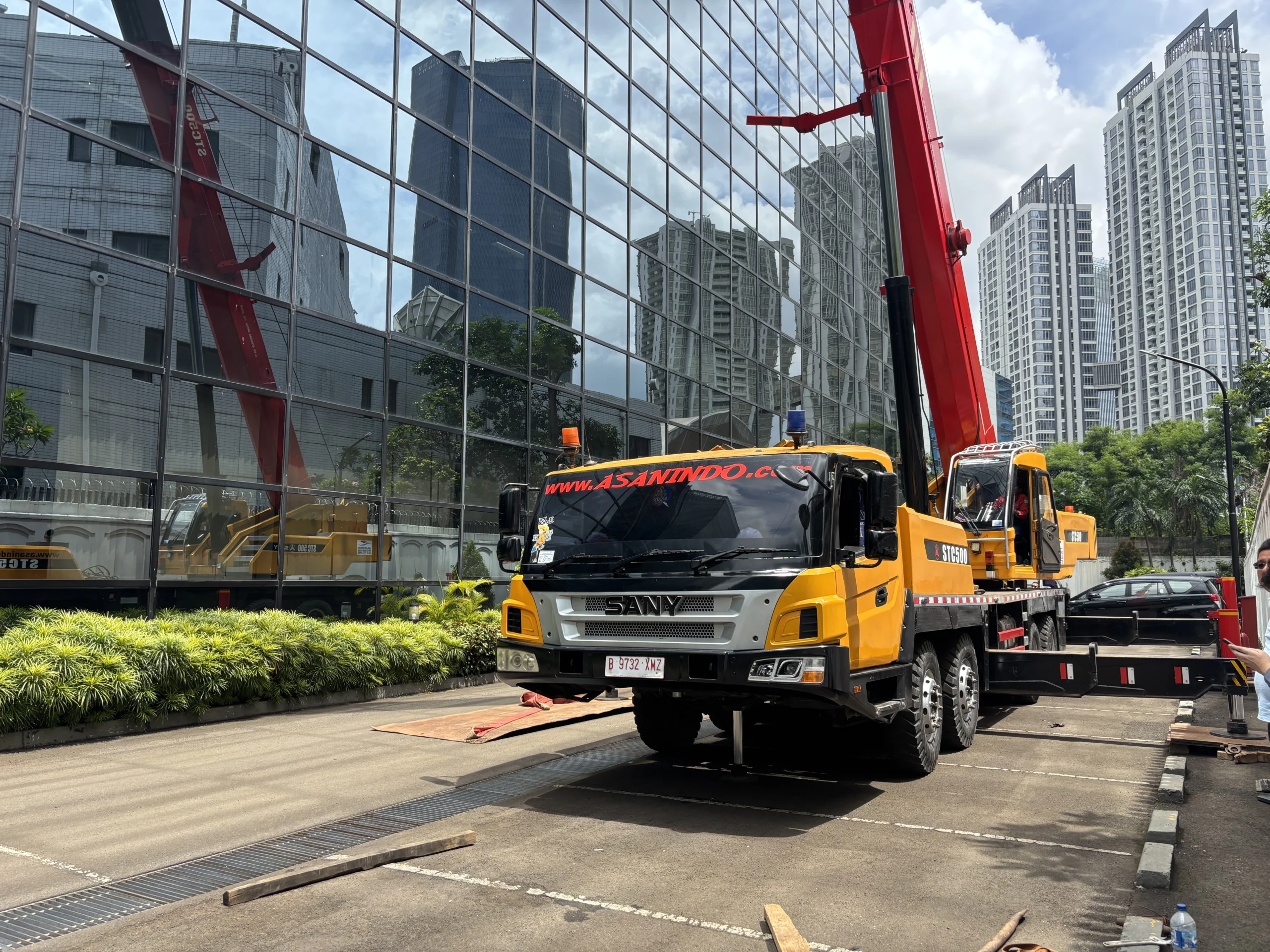
A standard container has an internal height of about 2.4 meters and a width of 2.3 meters—a space that is too narrow for a crane to fit inside. Mobile cranes are used from the outside container: The crane boom is positioned above the container door opening or above the flat rack, and then the sling is lowered inside to secure the machine and lift it out vertically.
This is a high-precision operation — the crane boom must be positioned directly above the machine's lifting point, and the lift must be performed vertically so the machine does not touch the container walls as it comes out.
✅ Sufficient Capacity for Heavy Machinery
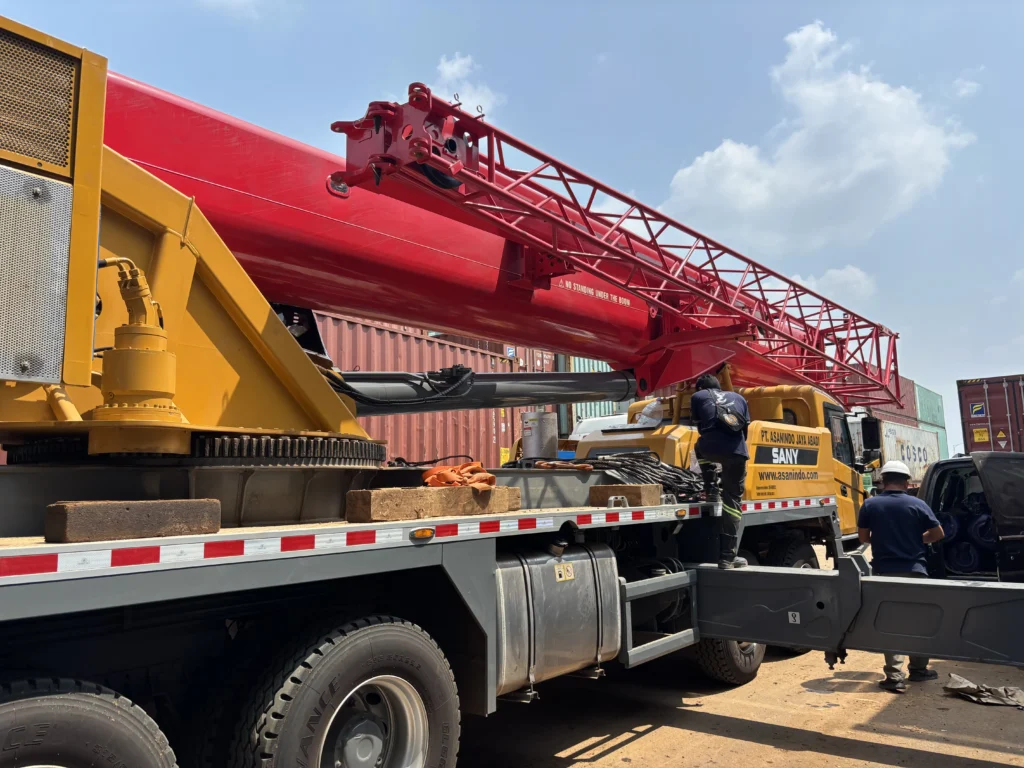
Mobile cranes are available in capacities suitable for nearly all types of industrial machinery—from 8-metric-ton cranes for small- to medium-sized machines to 50- or 55-metric-ton cranes for large machines such as hydraulic presses, large injection molding machines, or industrial reactors.
✅ Can directly move to a further position
Once unloaded from the container, the mobile crane—with its boom extended—can immediately move the machine to a specific location: through the factory door (if the height and width allow), onto a platform, or to a transfer point for further transport using other equipment.
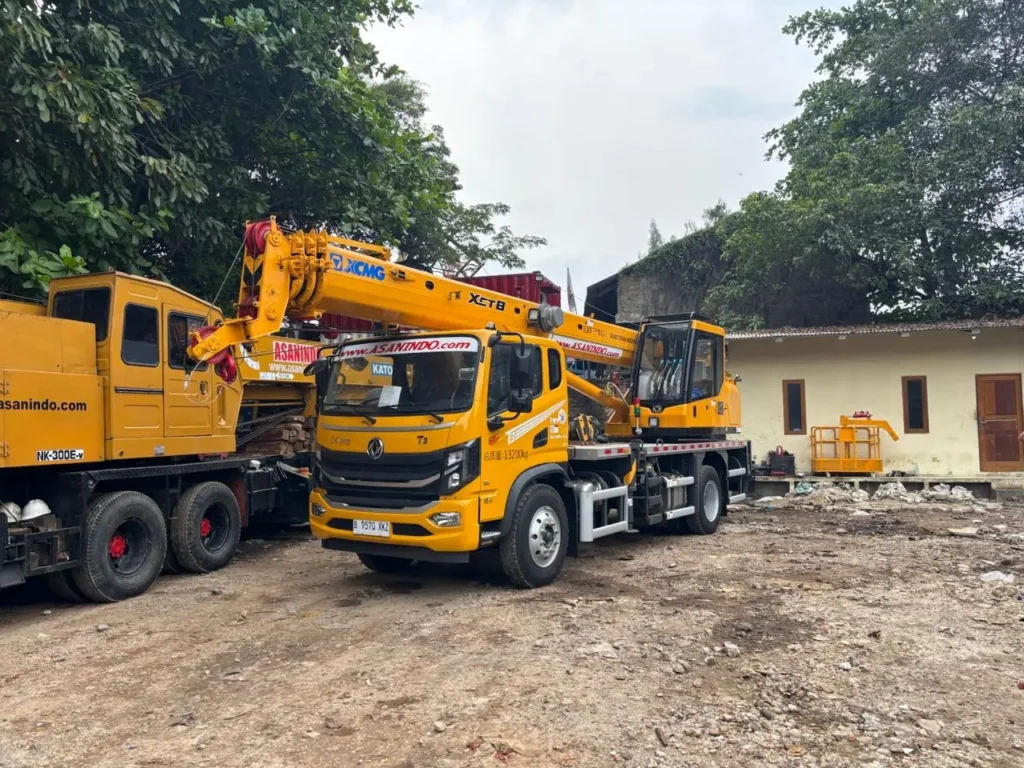
The Right Crane Capacity for Your Machine's Weight
Before ordering a crane to unload the engine, the first thing you need to know is actual weight of the machine — then determine the crane’s capacity using an adequate safety factor.
| Engine weight | Recommended Crane | Price/Shift |
|---|---|---|
| Under 3 tons | Mobile Crane 8 Ton (XCMG XCT8) | 3,500,000 Indonesian Rupiah |
| 4 – 10 ton | 8 Ton or 25 Ton Mobile Crane | Rp 3,5 |
| 10 – 15 tons | 25 Ton Mobile Crane | 4,800,000 IDR |
| 15 – 18 ton | 30 Ton Mobile Crane | 5,500,000 Indonesian Rupiah |
| 18 – 30 ton | 50 Ton Mobile Crane | Rp 8,000,000 |
| 30 tons and above | Mobile Crane 55 Ton (SANY STC550C5) | 8,600,000 IDR |
*Depending on the required working radius and height
⚠️ Important: The table above is an initial guide based on machine weight at a medium working radius. The effective capacity of the crane decreases as the radius increases. Always consult our team regarding machine weight, dimensions, and site conditions for accurate recommendations.
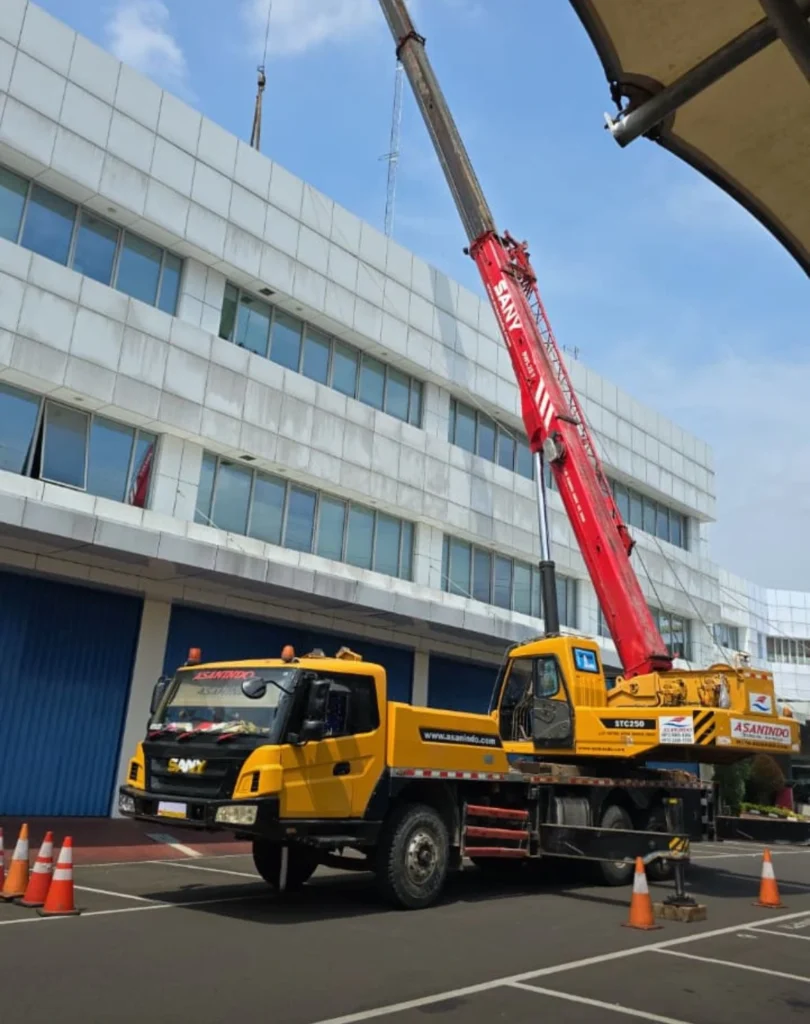
Phase 2: Internal Transportation within the Factory — Combination of Forklift and Machinery Mover
After the machine was successfully removed from the container, the next challenge was moving it to the installation location inside the factory. This is where the crane's limitations began to show—and other tools took over:
Forklift — For Machines That Can Be Lifted from Below
Forklift is a very efficient choice for moving machinery inside the factory if The machine has suitable lifting points for forklift tines (fork entry) and its weight is within the capacity of the available forklift.
Forklift advantages: very agile in factory aisles, can turn in a short radius, and is available in various capacities.
Limitations: can only lift from underneath (requires appropriate fork entry), and capacity is limited compared to cranes for extremely heavy machinery.
Machinery Mover / Skate — For Machinery That Cannot Be Lifted
For machinery that is too heavy for a forklift or that does not have suitable lifting points, machinery mover (or “machine dolly” / “machinery skate”) is a solution that is often used:
- A rotating steel cylinder (roller) or special steel wheel is placed under the machine
- The machine can then be “pushed” or slowly pulled into the desired position
- This technique can handle very heavy machinery because the load is distributed across multiple contact points.
Crane + Forklift Combination
For machines that need to enter the factory through a door, the general process is:
- Mobile crane lifting the machine out of the container and lowering it into the factory (if the door is high enough) or to the area closest to the factory door
- Forklift taking over to move the machinery inside the factory aisles to the installation point
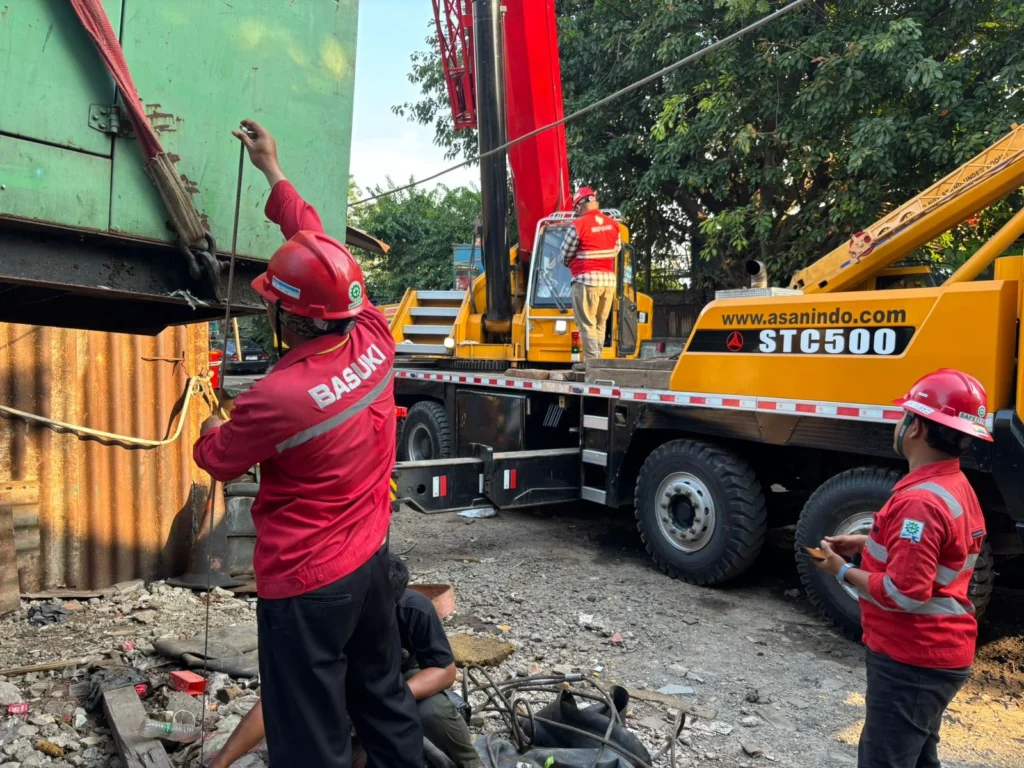
Mobile Crane for Setting Various Types of Machines — Our Experience
One of the advantages of a mobile crane that is often unrecognized is its flexibility for various types of industrial machinery. Our team has experience in setting up and relocating various types of machinery in the Jabodetabek industrial area, including:
Injection Moulding Machine
Plastic injection molding machines — ranging from 50 tons to 2,000 tons in capacity — are very common in factories across the Greater Jakarta area. Large injection molding machines have a very significant weight (reaching tens of tons) and require highly precise positioning because they must connect to already installed material distribution, cooling, and control systems.
🔧 Hydraulic Press Machine
A large-capacity hydraulic press is an extremely heavy and tall machine—a combination that makes its setup very challenging. A mobile crane is required not only to lift the press body, but often also to set the heavy upper and lower dies separately.
⚙️ CNC Machine and Machining Center
Although its weight may not be as heavy as a hydraulic press, a CNC (Computer Numerical Control) machine is extremely sensitive to shocks and inclination. Improper lifting can shift precision internal components such as the spindle, guide rail, or ball screw, which have very strict calibrations.
🏗️ Industrial Compressors and Generators
Industrial air compressor units, generator sets, and large plant utility equipment often have to be lifted over walls or open roofs while the plant is under construction—or moved through existing doorways with the help of precision cranes.
🔆 Large Transformers and Electrical Panels
The high-voltage transformer for the factory has a very large weight and must be placed in a very specific position. A mobile crane is the only tool that can lift and position this large transformer with the required precision.
🌀 Reactor, Process Tank, and Industrial Vessel
In chemical, pharmaceutical, and food processing plants, heavy process tanks and reactors must be installed with extreme precision. Mobile cranes — especially those with a capacity of 30 tons and above — are the primary equipment for this work.
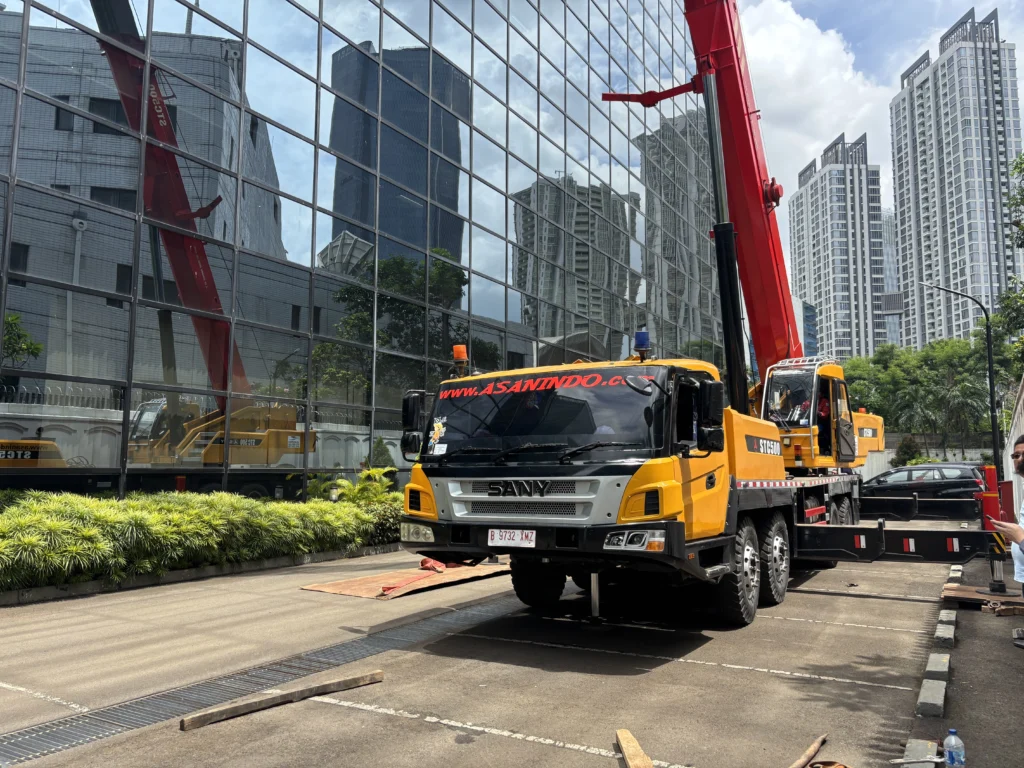
Critical Things to Prepare Before the Crane Arrives at the Factory
Lifting machinery in a factory environment requires more thorough preparation than lifting at an open construction site. Here is the checklist we recommend to clients before the D-day:
📋 Before the Big Day
✅ Prepare accurate machine technical specifications Exact machine weight (check datasheet or nameplate), dimensions (length × width × height), lifting point position (lifting eye, eyebolt, or manufacturer-recommended points), and the weight of the machine after additional components are installed.
✅ Measure and verify all access Width of the factory entrance, height of the overhead clearance (including cables, pipes, and structures above the entrance path), aisle width from the door to the installation point, and floor load capacity at the points where the machine will pass and be placed.
✅ Mark the installation point clearly Use paint or permanent markers on the floor to mark the exact position of the machine. Positioning precision is crucial—especially for machines that must connect to already installed utility systems (pipes, cables, cooling ducts).
✅ Coordinate with the utilities team Make sure all connections to be linked to the machine (electricity, water, compressed air, gas) have been prepared and are easily accessible from the planned installation position.
✅ Clear the access path Remove all obstacles from the path between the entrance and the installation site—pallets, drums, small equipment, or anything else that might hinder the movement of heavy machinery.
📋 On the D-day
✅ Ensure technical representative is present Ideally, there should be a technician from the machine manufacturer or at least an in-house engineer who understands how to handle this machine according to the manual—especially when it comes to determining the correct lifting points.
✅ Team briefing before starting Crane operators, riggers, and all personnel involved must receive a briefing on the sequence of operations, communication procedures, and exclusive zones before operations begin.
✅ Document the engine's condition before and after Photos or videos of the machine’s condition before it is moved serve as important protection for all parties in the event of a damage claim after the work is completed.
Why Choose Rentalcranejabodetabek.com for Factory Machine Setting?
There are many crane vendors that can deliver units to your site. But for factory machinery installation projects involving high-value assets and complex work environments, you need more than just a crane:
✅ Real-World Experience in Factory and Industrial Park Environments Our fleet actively serves factories in the Jabodetabek industrial areas—Cikarang (MM2100, EJIP, BIIE), Karawang, Tangerang, and Jakarta. Our team understands the unique challenges of working inside factory buildings—challenges that can’t be learned from a book.
✅ SIO-Certified Operator — Verified Competency All of our operators hold valid SIO certificates issued by the Indonesian Ministry of Manpower. For factory work involving expensive equipment, having truly competent operators is non-negotiable.
✅ Certified Professional Rigger We provide experienced and certified riggers—including for machinery rigging jobs that require an understanding of lifting points, centers of gravity, and proper lashing techniques for various types of machinery.
✅ Complete Fleet from 8 Tons to 55 Tons No matter how heavy the machinery you need to move is, we have the right unit in our fleet. We don’t have to settle for a crane that’s “just good enough”—we can provide a unit with the exact capacity you need.
✅ Quick Response — Even for Urgent Needs A machine breakdown that requires immediate replacement? A new machine arriving ahead of schedule? Our team is available 24 hours a day and ready to handle rush orders for factory needs that can’t wait.
✅ Transparent Pricing — All-Inclusive Per-Shift Rental Rates All of our per-shift rental rates include a SIO-certified operator, fuel, meal allowance, and transportation within the Jabodetabek area. There are no unexpected charges that suddenly appear on the final bill.
FAQ: Frequently Asked Questions About Cranes for Factory Machinery
Q: Can a mobile crane enter the factory building to set up machinery? A: It depends on the crane’s dimensions and the factory’s conditions. A mobile crane requires sufficient overhead clearance for its boom (when folded, the crane’s height can reach 3–4 meters or more, depending on its capacity) and adequate access width for the unit’s width. For factories with sufficiently high doors and ceilings, the crane can enter the facility. For factories with these limitations, the crane typically remains outside and lifts the machinery inside through a door or roof opening. A site survey prior to mobilization is essential to determine the best approach.
Can the crane set the machine directly in its final position, or does it require another tool for final positioning? A: A crane can handle most of the positioning work—including lowering the machine very close to its final position. However, for the final adjustment of a few centimeters (micro-adjustment) to position the machine exactly at the marked spot, manual chain blocks, steel jacks, or machinery rollers are often used because these tools provide more precise control for very small movements.
Can cranes be used for night work if the equipment must be installed outside of production hours?A: Yes. We provide services at night and outside normal business hours—including weekends and holidays. Services provided outside normal business hours are subject to a surcharge, which we always specify upfront in our written quote.
Q: What is the estimated time required to unload a machine from a container and set it up in its final position? A: It varies greatly depending on the machine’s weight and dimensions, access conditions, and the complexity of positioning. For medium-sized machines (5–15 metric tons) with good access, the process from unloading the container to placing the machine in its final position can be completed in 2–4 hours. Larger machines or more complex access conditions may require a full shift or even longer.
What should I do if I don't know the exact weight of the machine to be moved? A: Check the machine’s nameplate or data sheet—manufacturers always list the unit’s weight. If that information isn’t available, contact the machine’s agent or distributor. As a last resort, we can help you estimate the weight based on the type, size, and material of the machine you’ve described. Never guess the weight of a machine without a clear reference—this is one of the greatest sources of risk in machine lifting operations.
Our Services in the Jabodetabek Industrial Area
We actively serve factories in:
- Cikarang — MM2100, EJIP, BIIE, Hyundai Esti, Delta Silicon, Jababeka
- Karawang — KIIC, Suryacipta, and other industrial estates
- Bekasi — Bekasi City and Bekasi Regency
- Tangerang — Tangerang City, South Tangerang, Serpong, Cilegon
- Jakarta — The entire DKI Jakarta region
- Bogor — Bogor City, Cibinong, and surrounding areas
Contact Us — Crane Solutions for Your Factory Machinery
Have a machine that needs to be unloaded from a container? Need to relocate machinery within the plant? Or install new industrial equipment that requires a crane with the right capacity?
Tim Rentalcranejabodetabek.com Ready to help — with the right units, certified operators, and real experience in the Greater Jakarta manufacturing industrial environment.
📞 WhatsApp / Phone (Fast Respon 24 Hours):
0813-8080-1729
(Davin Aubade)
🌐 Website: www.rentalcranejabodetabek.com
“Tell us about your machine — its weight, where it is coming from, where it is going, and the access conditions. Our team will recommend the most efficient and safe heavy equipment solution for your specific factory needs.”
Related Articles & Services
- 🔗 8 Ton Crane Rental — Rp 3,500,000/shift, for light machinery & restricted areas
- 🔗 Crane Rental 25 Ton — IDR 4,800,000/shift, for medium factory machinery
- 🔗 Crane Rental 30 Ton — Rp 5,500,000/shift, the most popular choice for manufacturing
- 🔗 Crane Rental 50 Ton — IDR 8,000,000/shift, for heavy machinery & large presses
- 🔗 Crane Rental 55 Ton SANY STC550C5 — Rp 8,600,000/shift, highest capacity
- 🔗 Functions of a Crane Rigger — professional rigger for machine setup
- 🔗 Mobile Crane Capacity Guide — how to calculate tonnage according to machine weight
- 🔗 24-Hour Mobile Crane Rental Near You — fast response for breakdown & rush
- 🔗 Crane Rental Price Per Shift — full rate 2026
- 🔗 Contact Us free consultation