



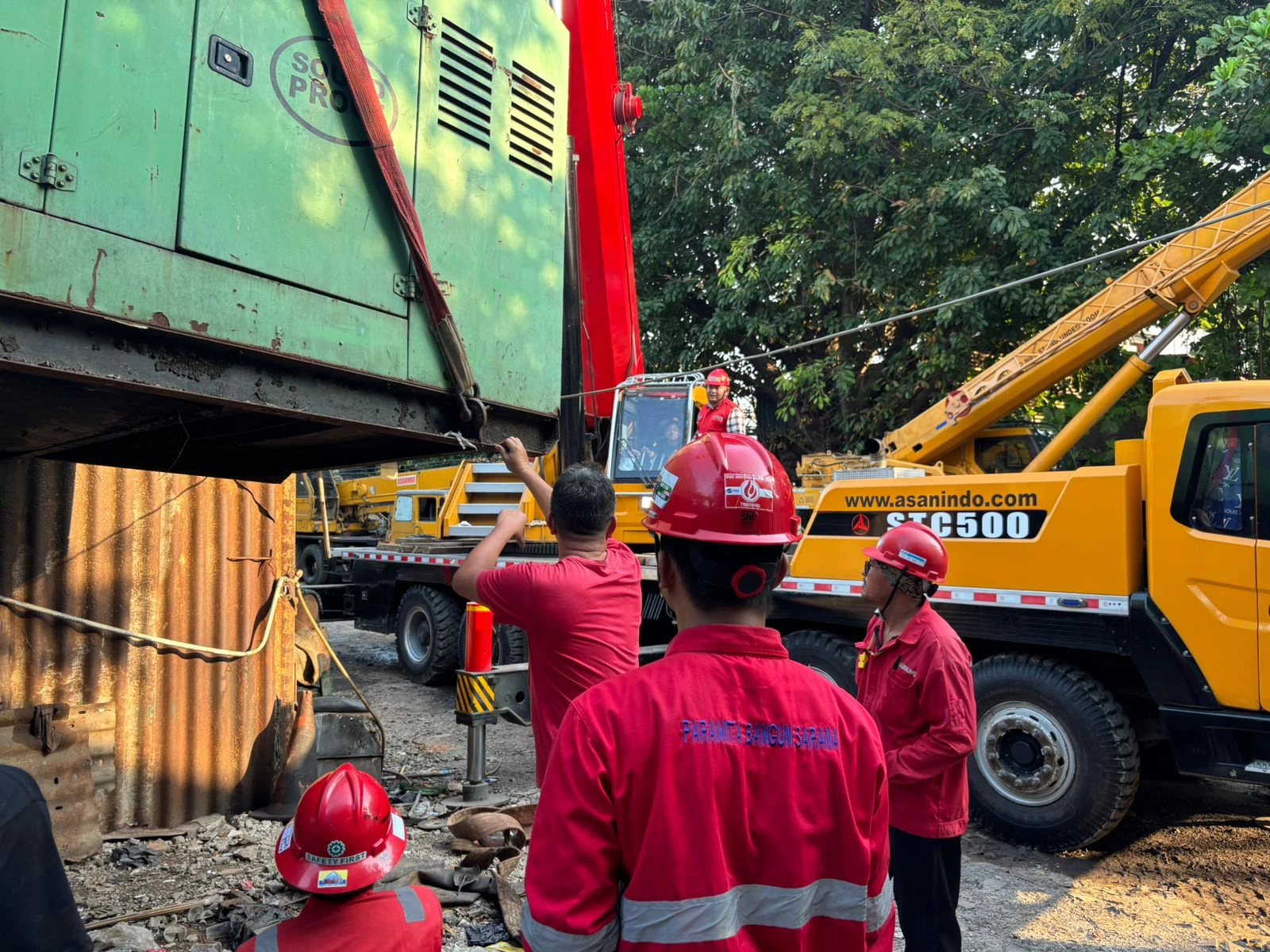
When a crane lifts a heavy load 20 meters high and places it with millimeter precision onto a newly installed steel frame — all that is seen is the crane. What is often unseen, but just as crucial, is the person standing below: rigger.
Rigging is a profession that is often overlooked, even though Without a competent rigger, no lifting operation can be performed safely — no matter how sophisticated the crane or how experienced the operator.
This article fully explains who riggers are, what they do, why official certification is very important, and how PT Asanindo Jaya Abadi Providing certified professional rigger services as part of integrated lifting solutions in Jabodetabek.
What is a Rigger?
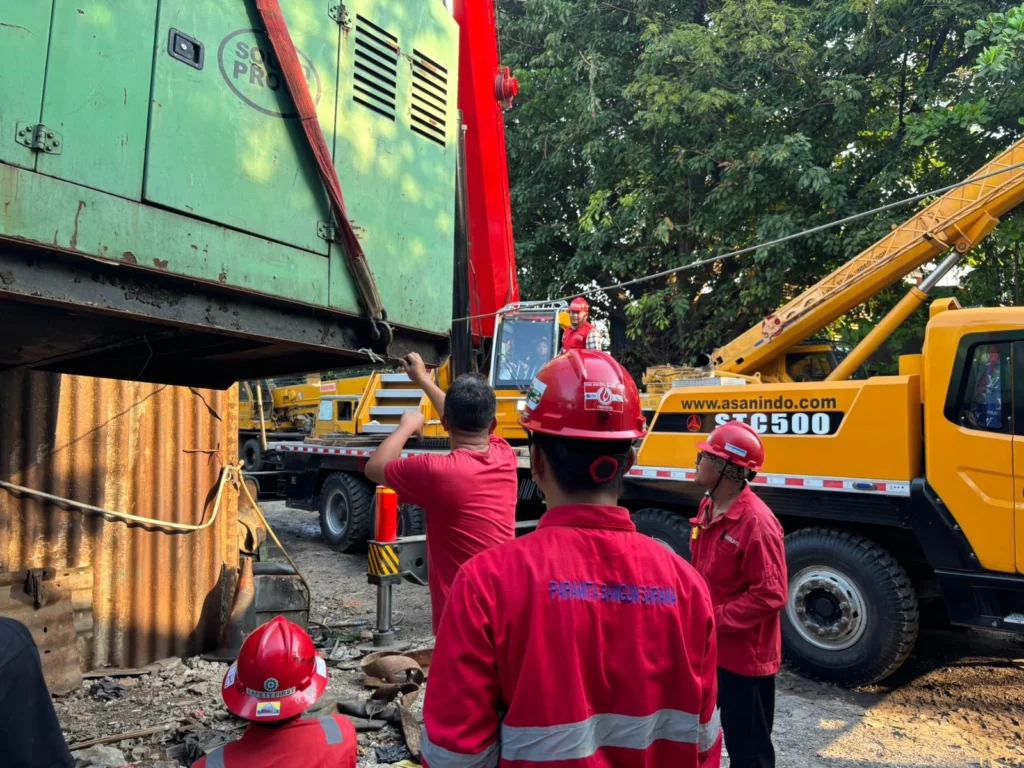
In the construction and lifting industry, rigger is a field expert responsible for all aspects Binding, securing, and guiding Load to be moved using lifting equipment such as a crane.
Simply put: if the crane operator is the “pilot” driving the crane from the cabin, then the rigger is the “ground crew” ensuring the load is properly and safely secured, and ready to be lifted — as well as guiding the operator during the lifting process.
The job of a rigger isn't just “tying ropes to things.” It is a demanding job:
- Technical knowledge about the capacity and operation of various types of rigging equipment
- Calculation ability weight distribution and center of gravity of the load
- Field skills when installing and inspecting slings, shackles, spreader bars, and other rigging hardware
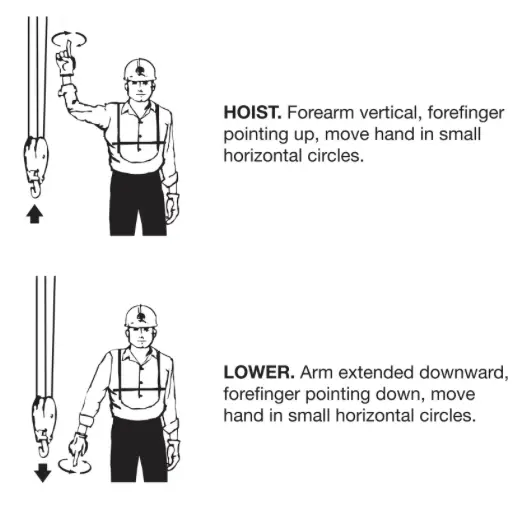
- Effective communication with crane operators—including understanding and using standard hand signals
- Risk assessment fast and accurate in a dynamic work environment
One rigging error in the field—an improperly attached sling, incorrect lift points, or unbalanced load—can result in a dropped load, serious injury, or property damage. This is why riggers are a profession that cannot be filled by just anyone.
Rigger's Duties and Responsibilities on Site
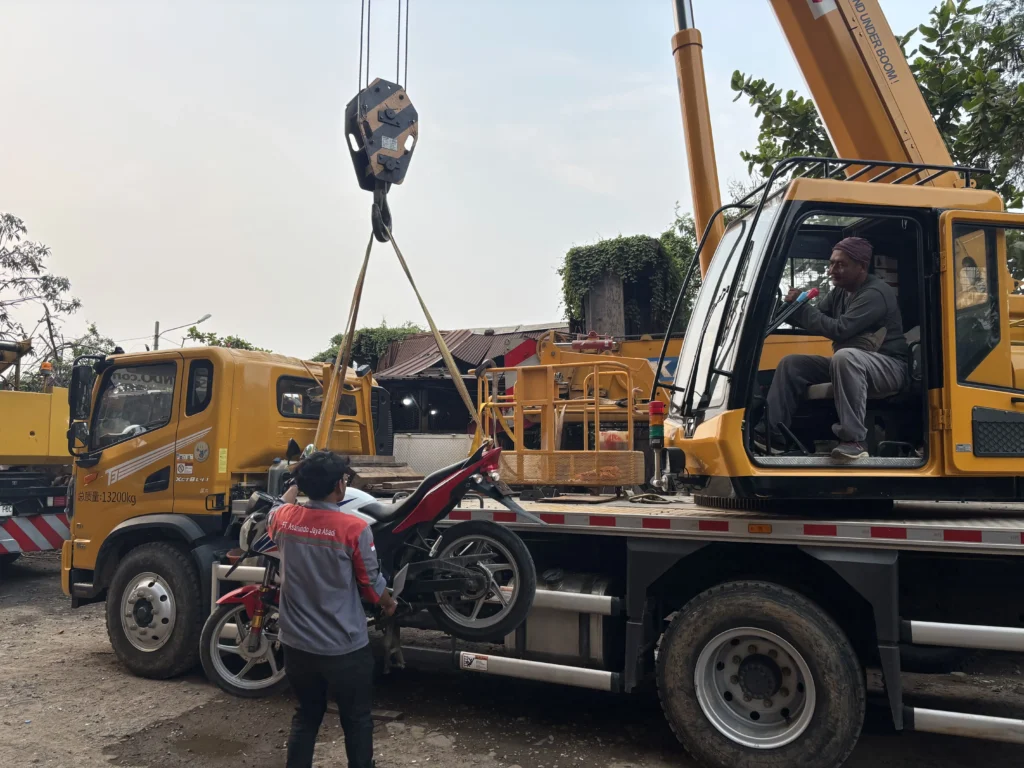
The work of a rigger covers the entire operational cycle of lifting — from preparation before the crane arrives until the load is successfully placed in its intended position. Here are the specific tasks that are the responsibility of a rigger:
📋 Before Lifting Begins
Learning and understanding the lifting plan Before any rigging component is installed, a good rigger studies the lifting plan – a document that contains the lifting method, crane position, load lifting points, and applicable safety procedures. The rigger must understand the entire operation, not just the small part that is directly their responsibility.
Inspect all rigging equipment Every sling, shackle, hook, spreader bar, and other rigging accessory must be inspected for condition before use. Riggers look for signs of damage: broken wires on wire rope slings, excessive rust, deformation, or wear exceeding tolerance limits. Unserviceable equipment must be replacedbefore work begins - no compromises.
Calculate and verify rigging capacity Based on the load weight and the lifting angle to be used, the rigger calculates whether the available sling and shackle capacity is adequate with the appropriate safety factor. Sling angles greater than vertical will reduce the effective capacity - and the rigger must account for this.
Determining the lifting points and center of gravity of a load Not all loads have evenly distributed weight. Riggers must identify or estimate the position of the load's center of gravity to determine the lifting points that will cause the load to be lifted in the correct position—not tilted to one side which could cause the load to swing uncontrollably.
🔧 During the Rigging Process
Installing slings and rigging equipment on loads This is the core of a rigger's technical work. Slings are attached to designated lift points, shackles are properly secured, and all components are double-checked before the “lift ready” signal is given to the operator.
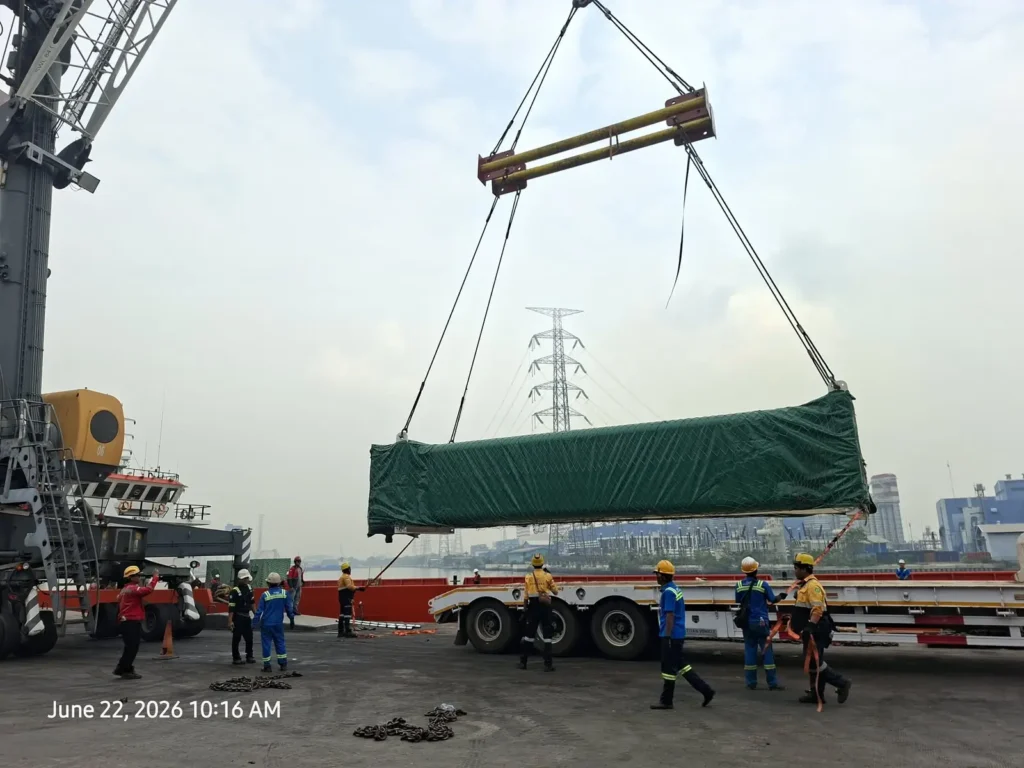
Install tagline (control rope) On long, wide, or potentially swinging loads, riggers attach tag lines—extra ropes held by ground crew members to control the load's movement while in the air and prevent dangerous swinging.
Ensure the area is safe before lifting Before the crane begins to lift, the rigger ensures that no one is under or within the danger radius of the load to be lifted. The exclusion zone must be clear of unauthorized personnel.
📡 During Lifting Operations
Communicating with a crane operator This is one of the rigger's most critical roles. Using standard hand signals (or radio communication for more complex operations), the rigger guides every crane movement: lift, lower, left, right, stop. The crane operator follows the rigger's instructions, who has direct visibility of the load and work area.
Monitor load conditions during lifting The rigger continuously monitors the load's condition while in the air—whether its position is correct, if there are any signs of the sling shifting, and if the load is moving as planned. If something is wrong, the rigger immediately signals the operator to stop.
Control tagline The rigging crew actively controls the load with taglines to prevent swinging during aerial transport—this is particularly important when the load passes through narrow areas or in less-than-ideal wind conditions.
✅ After the Load is Placed
Ensure the load is secure in the destination position After the load is lowered to its destination, the rigger ensures the load is stable and secure before releasing the slings. An unstable load that has its slings released can shift or fall.
Dismantle and inspect rigging equipment After the lift is completed, the slings and other equipment are removed, inspected for condition, and stored properly for future use.
Rigger's Equipment: Getting to Know Rigging Equipment
Riggers work with various types of fastening and lifting equipment. Understanding this equipment helps you as a client to better appreciate the complexity and skill involved in rigging work:
🔗 Wire Rope Sling (Steel Cable Sling) Made from twisted steel wires. Very strong and resistant to heavy loads. Available in various diameters and constructions for diverse applications. Must be checked regularly and replaced if there are broken wires, severe corrosion, or deformation.
Chain Sling High-strength steel chain, highly resistant to heat and sharp surfaces — more durable than wire rope in certain conditions. Heavier than wire rope of similar capacity, but easier to handle and store.
Webbing Sling Made from woven synthetic fibers (polyester or nylon). Lighter and softer on scratch-prone load surfaces. It has a more limited capacity than wire rope or chain, and is more susceptible to damage from sharp objects or heat.
Bolt U-shaped connector with locking pins that connects a sling to a crane hook or a load lifting point. Each shackle has a load capacity marked on its surface—and this capacity must always be checked before use.
📏 Spreader Bar / Lifting Beam Rigid steel bars used to distribute loads horizontally across multiple lifting points. They are essential for lifting long loads (like steel girders) to prevent bending or damage from excessive sling angles.
Tag Line Ropes attached to a load to control its movement while in the air. Prevents the load from swinging and helps to precisely position the load at the desired location.
Rigger Certification: Why SIO Rigger Certification Is Crucial
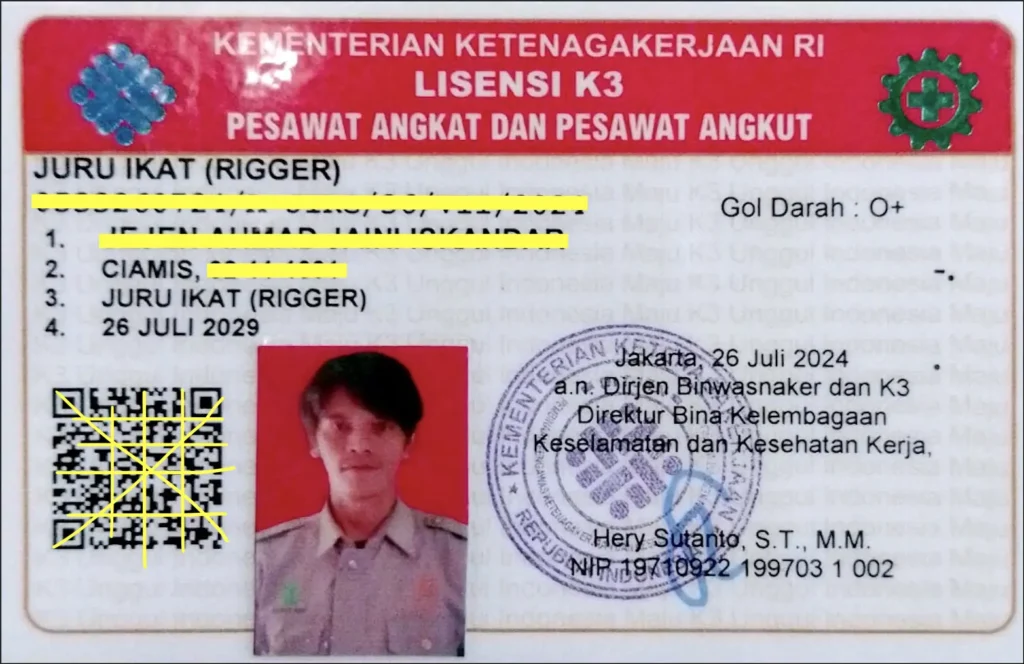
In Indonesia, rigging work on projects requiring high safety standards—such as large industrial projects, ports, or facilities regulated by the Ministry of Manpower RI—requires riggers who have Operator Permit (SIO) Rigger still valid.
What is a SIO Rigger?
SIO Rigger is an official license issued by Ministry of Manpower of the Republic of Indonesia (Kemnaker RI)that proves someone has:
- Participate in structured rigging training that meets established curriculum standards
- Declared competent through an examination that assesses technical knowledge and practical ability
- Understand and commit to implementing K3 standards in every rigging job
SIO Rigger is not just an administrative document. It is proof that the holder know what they are doing— from how to calculate sling capacity, how to read a load chart, how to identify unsuitable rigging equipment, to how to communicate with the crane operator effectively and safely.
Why Do Projects Need Certified Riggers?
Regulatory and legal compliance Ministerial regulations for manpower stipulate that the operation of lifting and transporting equipment in the workplace must be carried out by competent personnel, evidenced by official certification. Using riggers without a SIO (Operator Certification Card) on projects where it is required can result in a reprimand, fines, or operational suspension by labor inspectors.
Uncompromisable safety More than just a regulation, rigger certification is about real-world safety on site. A rigger who isn't properly trained not only endangers themselves but also endangers everyone in the work area, including the crane operator, other workers on site, and even the public around the project location.
Industrial and port project requirements Projects with high safety standards—such as petrochemical projects, power facilities, and international port areas like JICT—explicitly require certified riggers as part of their OHS management system. Without certified riggers, a work permit for lifting operations might not be issued.
The Difference Between a Rigger and a Crane Operator: Two Complementary Roles
Many people mistakenly believe that crane operators can also perform rigger duties, or vice versa. This is a dangerous misconception.
| Aspect | Crane Operator | Rigger |
|---|---|---|
| Work position | Inside the crane cabin | In the field, near the load |
| Main responsibility | Operating crane movements | Lashing and guiding loads |
| Visibility | From the cabin height, limited | Directly see the load and workspace |
| Certification | SIO Crane Operator | SIO Rigger |
| Communication | Receive and execute signals | Providing signals and directions |
| Main equipment | Control the crane in the cabin | Sling, shackle, spreader bar, tag line |
Both of these roles mutually dependent and irreplaceable. Operators working without a rigger lack sufficient visibility of the load condition and work area. Riggers without operators do not have the tools to move the load. Both are a team that must work in coordination to achieve safe and efficient lifting.
PT Asanindo Jaya Abadi: One Stop Solution for Rigging & Lifting
Many clients come to us needing only a crane. But many also realize that A crane alone is not enough. — they also need competent riggers to ensure the job is done safely and efficiently.
That's why PT Asanindo Jaya Abadi building capabilities as One-stop solution for rigging and lifting:
✅ Certified Professional Rigger SIO
Our rigging team holds a valid SIO Rigger certification from the Ministry of Manpower of the Republic of Indonesia. They are not just helpers who can tie ropes – they are trained professionals who understand:
- How to read and interpret a load chart
- How to calculate sling capacity at various lifting angles
- How to identify unsuitable rigging equipment
- Standard hand signals and communication with operators
- Occupational safety and health (OSH) procedures in dynamic field conditions
✅ Armada Mobile Crane Complete
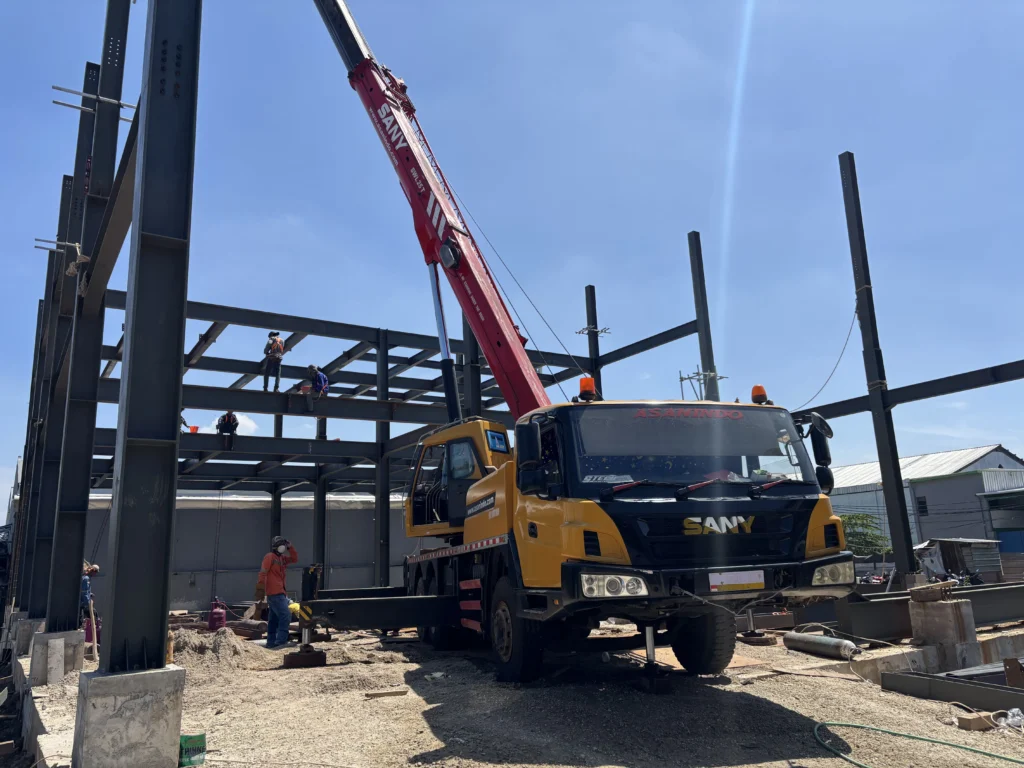
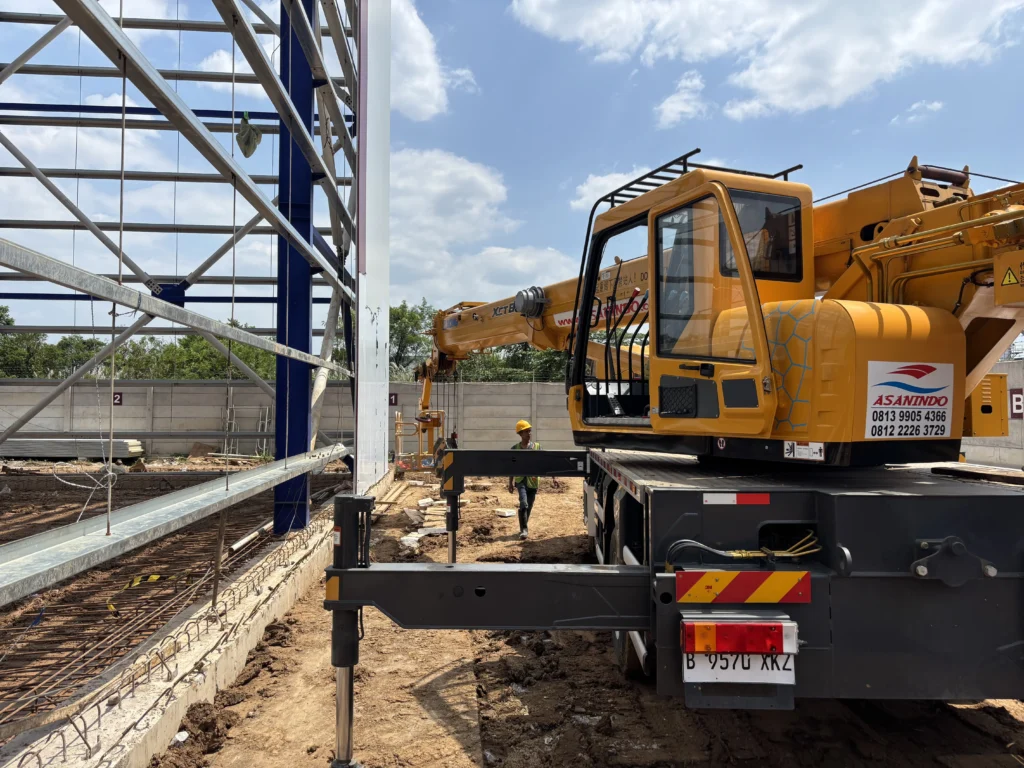
From 8-ton crane for work in confined spaces up to SANY STC550C5 55-ton crane For industrial-scale heavy lifting — our fleet is ready to support various lifting job scales and types.
✅ Certified SIO Crane Operator
All of our crane operators hold valid SIO Operator credentials. Our operators and riggers are accustomed to working together as a coordinated team, resulting in safer and more efficient lifting operations.
✅ Integrated Service: Crane + Rigger + Planning
When you rent a crane from us and need a rigger, you get a team that is accustomed to working together — not a random combination of operators from one vendor and riggers from another who have never worked together before. Good coordination between operators and riggers is one of the most important factors in lifting safety.
✅ Active 24 Hours, Including for Rush Orders
Rigger needs cannot always be planned far in advance. Our team is available 24 hours, including for sudden needs and emergency work.
FAQ: Frequently Asked Questions About Crane Riggers
Q: Does every lifting job require a rigger? Every lifting job involving cranes and loads secured with slings requires someone performing the function of a rigger — whether it's a certified rigger or trained personnel who understand proper rigging procedures. For large industrial projects, ports, and facilities strictly regulated by OHS regulations, an SIO-certified rigger is a mandatory requirement. For smaller projects, there must at least be personnel who understand rigging procedures correctly.
Can a crane operator also work as a rigger? It is not recommended and, in many situations, not practically safe. Crane operators are inside a cabin with limited visibility of the area below and around the load. Riggers must be in the field to have direct visibility. Performing both roles is physically impossible in actual lifting operations.
Q: How many riggers are needed for one lifting operation? It depends on the complexity of the lift. For simple lifts with a single load in an open area, one rigger might suffice. For more complex lifts—long loads requiring tag lines from multiple directions, or lifts in congested areas—two to four riggers or more may be necessary. This is part of the lift planning that must be determined before operations begin.
A: Can PT ASANINDO JAYA ABADI provide certified riggers? Yes. PT Asanindo Jaya Abadi provides certified SIO professional riggers as part of our integrated lifting services. Contact us to discuss your project's rigging needs—whether as a package with cranes or as a standalone service.
What should I prepare on-site before the riggers and crane arrive? Here are some things that are very helpful: (1) ensure access to the loading location is open and clear, (2) prepare accurate weight and dimension information for the load, (3) identify lifting points on the load (if lifting lugs or eyebolts are already present), (4) ensure the area around the lifting points and the lifting path is clear of people and obstacles. Our team can also conduct a pre-site survey to ensure proper preparation.
Lifting safety is a shared responsibility
Every crane operation, no matter how small, involves potential risks that cannot be taken lightly. Loads of hundreds of kilograms hanging in the air are a real danger if not handled with the correct procedures.
This is why we always emphasize the three pillars of lifting safety:
The right crane — adequate capacity, maintained, certified (valid SILO) 2. Competent operator — SIO certified, experienced, trained Trained rigger — SIO certified, understands rigging equipment and procedures
These three pillars must be met simultaneously. The weakness of one pillar can render the other two meaningless.
PT Asanindo Jaya Abadi committed to providing these three pillars in one integrated service — certified, trained, and seasoned crane, operator, and rigger teams accustomed to working together.
Contact Us — Integrated Rigging & Lifting Solutions
Need a crane Dan Professional rigger? Or do you just need a consultation on how many riggers you need for a particular project? Our team is ready to help.
📞 WhatsApp / Phone (Fast Respon 24 Hours):
0813-8080-1729
(Davin Aubade)
🌐 Website: www.rentalcranejabodetabek.com
“A call to certified professional crane and riggers — PT Asanindo Jaya Abadi is your one-stop solution for all your rigging and lifting needs in Jabodetabek.”
Related Articles & Services
- 🔗 Mobile Crane & Truck Crane Rental — our complete crane armada
- 🔗 8 Ton Crane Rental — for work in confined spaces
- 🔗 Crane Rental 30 Ton — most popular choices for construction
- 🔗 Crane Rental 55 Ton SANY STC550C5 — large-scale heavy lifting
- 🔗 Port Crane & Ship Rental — SIO & SILO valid for JICT
- 🔗 Mobile Crane Capacity Guide — how to choose the right tonnage
- 🔗 7 Types of Cranes and Their Functions — Complete Guide to Crane Types
- 🔗 Crane Rental Price Per Shift — latest rates 2026
- 🔗 24-Hour Mobile Crane Rental Near You — Fast response, rush order
- 🔗 Contact Us free consultation