



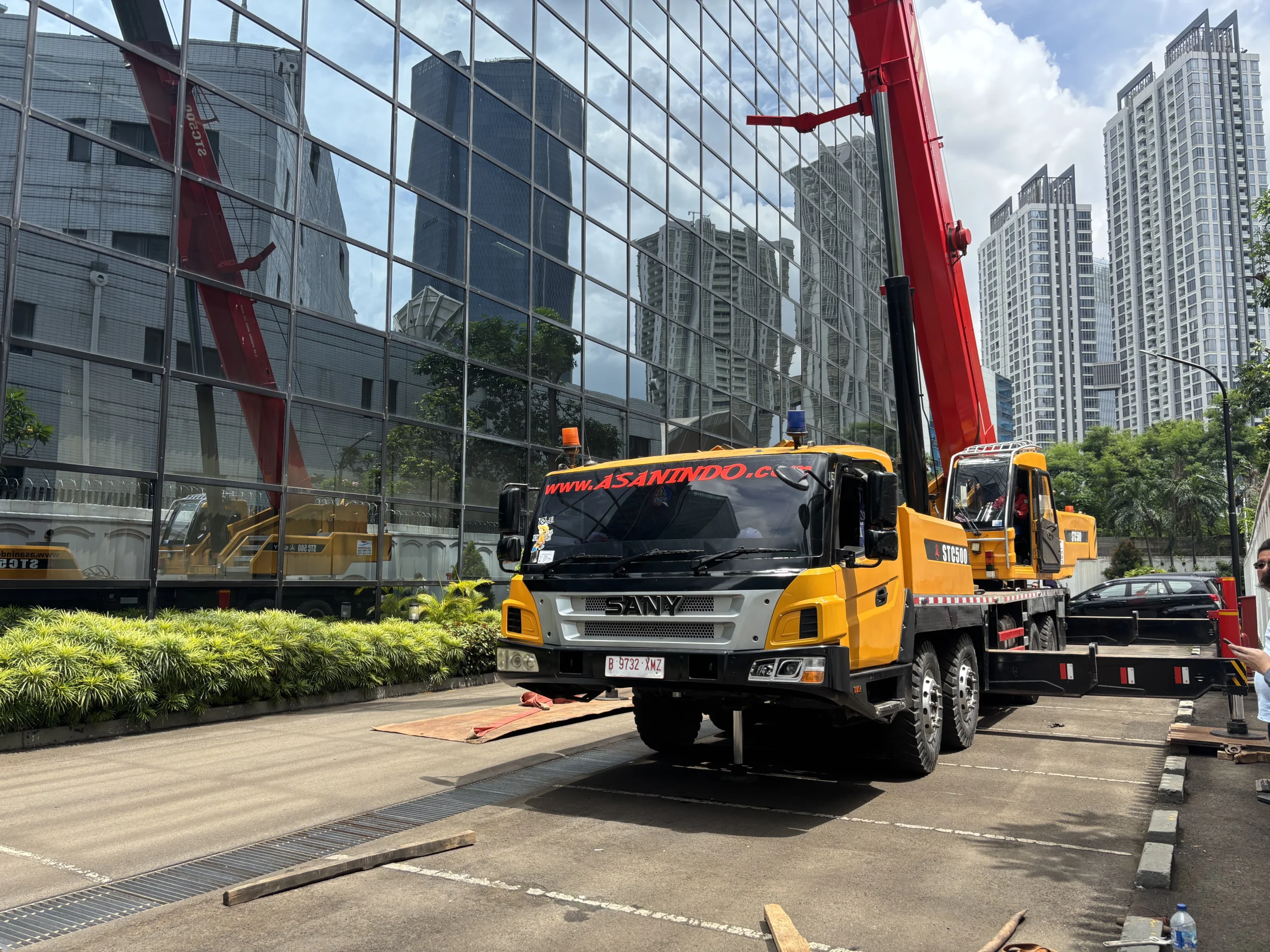
Transmission towers standing upright, 60-80 meters above buildings. BTS telecommunication towers that must be assembled from the bottom up in locations with difficult access. Tall steel structures for antenna arrays, water towers, or giant signage frames that require precise installation at heights that cannot be reached with ordinary scaffolding.
All of these jobs have one thing in common: They need the right crane. — which not only has sufficient lifting capacity but also adequate vertical reach, can maneuver in often-limited locations, and is operated by a team that understands the unique challenges of working at heights.
Choosing the wrong crane for a job like this isn't just about unfinished work — it can mean real safety risks for workers at height and people around the site.
This article guides you to understand The most suitable type of crane for tower installation and high-rise construction depends on the specific project requirements. However, common and effective crane types include: * **Tower Cranes:** These are the most iconic and frequently used cranes for tall buildings. They are fixed to the ground and can lift heavy loads to significant heights. There are several sub-types: * **Hammerhead Tower Cranes:** Versatile and widely used. * **Luffing Jib Tower Cranes:** Useful for sites with limited space or when the crane needs to swing over obstacles. * **Self-Erecting Tower Cranes:** Smaller and quicker to set up, suitable for medium-height structures. * **Mobile Cranes:** While less common for the very tallest structures where a tower crane is permanently fixed, mobile cranes can be used for certain stages or for shorter buildings: * **All-Terrain Cranes:** Highly mobile and capable of operating on rough terrain, offering flexibility. * **Telescopic Cranes:** Their boom extends telescopically, allowing for a range of working heights. **Factors to Consider When Choosing:** * **Height of the structure** * **Weight of the materials to be lifted** * **Site constraints (space, accessibility)** * **Wind conditions** * **Project duration and budget** For most large-scale tower and high-rise construction, **tower cranes are generally the most appropriate and efficient solution** due to their ability to reach extreme heights and handle continuous heavy lifting over extended periods., factors that determine choice, and how Rentalcranejabodetabek.com ready to support your project.
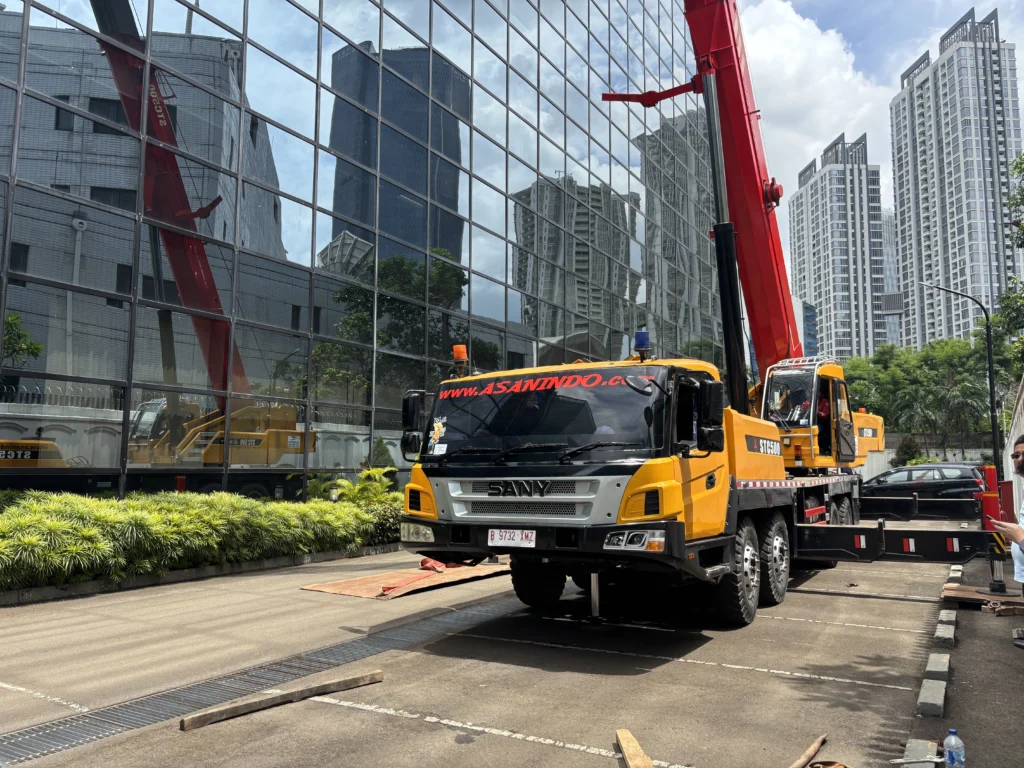
What Makes Tower Installation Different from Ordinary Construction?
Before discussing the right type of crane, it's important to understand why tower installation and high-rise construction present different challenges compared to conventional construction work.
🎯 Long Vertical Reach
Transmission towers, BTS towers, antenna poles, and other tall structures often need to be reached from below — and the heights that cranes must reach are far greater than in typical construction work. A crane with only a short boom would not be able to do this job, no matter how large its lifting capacity.
High Precision at Extreme Altitudes
Placing tower segments at the correct position at heights of 30, 40, or 50 meters requires extremely precise crane movement control. Stronger winds at altitude, swinging loads, and limited operator visibility make this task far more challenging than low-altitude lifts.
🎯 Locations are often limited
Transmission towers are not always located in large open areas. Many are on top of buildings, within residential areas, along roadsides, or in locations with very limited access. The cranes used must be able to maneuver in these conditions.
🎯 Variable Component Weight
Tower components vary from small, lightweight segments to large platforms, antenna arrays, or significant electronic equipment that must be lifted to the top of the structure. Cranes must have sufficient capacity for all components, including the heaviest ones.
🎯 Uncompromising Safety
Working at height with cranes is a combination of risks that requires extremely strict safety procedures. Mistakes at height can be far more fatal than mistakes on the ground.
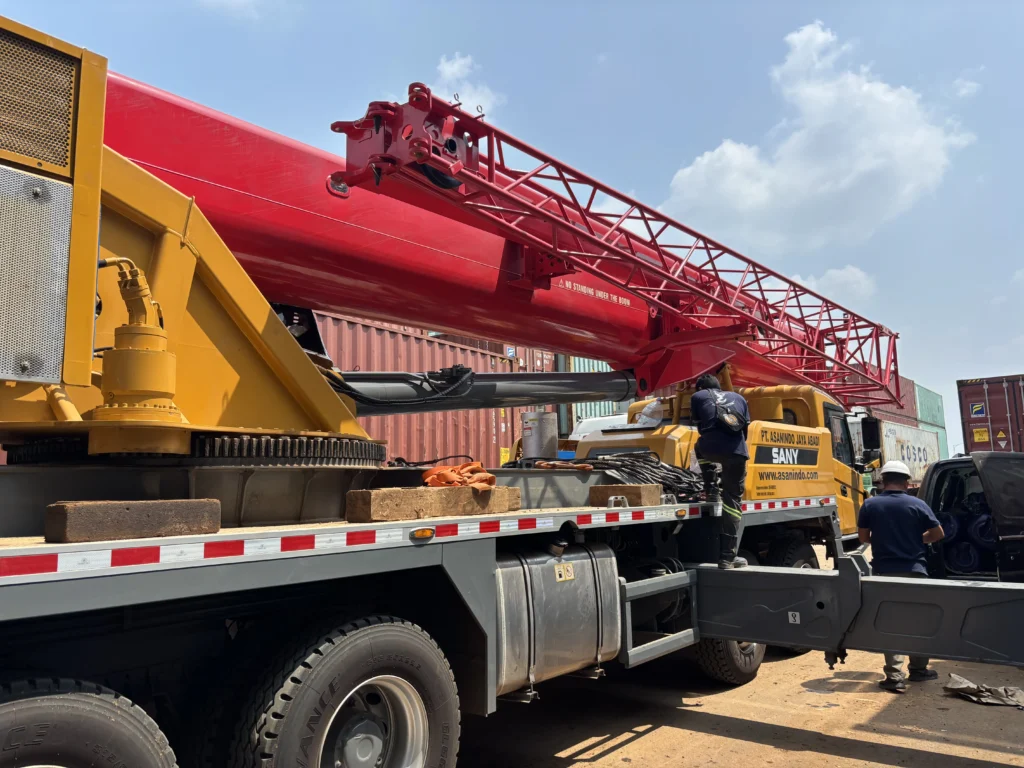
Types of Towers and Tall Structures Requiring Cranes
The term “tower installation” encompasses various types of projects with different characteristics. Here are the most common types of projects:
📡 Telecommunications BTS (Base Transceiver Station) Tower
BTS towers are cellular network infrastructure that stand in various locations—on top of buildings, on the ground, and by the roadside. Their height varies from 30 to 80 meters. The installation of BTS towers involves lifting tower body segments, platforms, antenna arrays, and electronic equipment to significant heights.
Typical challenges: Many BTS towers are installed in densely populated urban locations with limited road access. The cranes used must be able to enter narrow areas while also having a boom long enough to reach the installation height.
Radio and Television Broadcasting Tower
Radio and TV broadcast towers are often taller than cell towers, reaching 100 meters or more for large broadcast stations. The segments of broadcast towers are generally heavier too, requiring cranes with greater lifting capacity.
🏗️ Crane Tower (Tower Crane) — Installation Irony
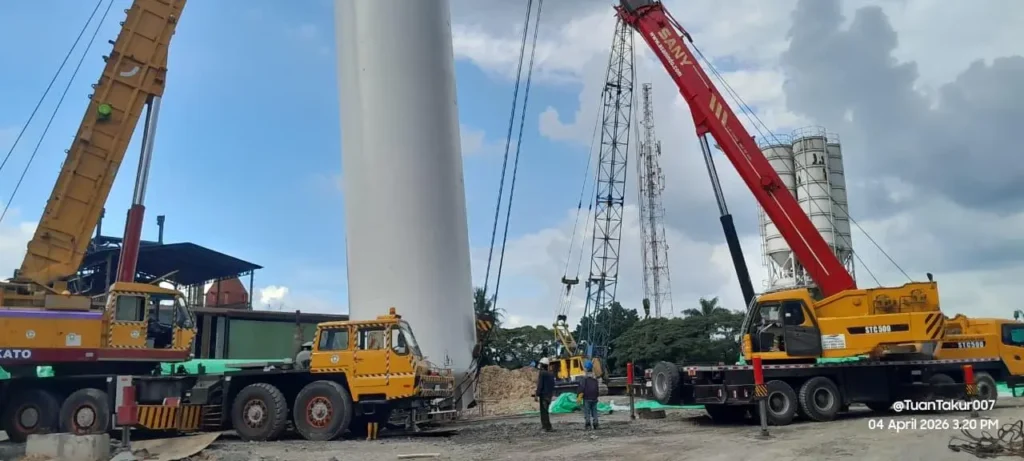
Interestingly, even tower cranes have to be erected using mobile cranes! To lift and assemble the mast and components of a tower crane at a building construction site, a sufficiently large mobile crane with a long boom is required.
💧 Water Tower
A communal or industrial water tower has a tank at its peak that must be lifted into a position 15–40 meters high. The combination of the tank's height and weight (especially once its components are installed) requires a crane with the appropriate specifications.
📶 Antennas and Broadcast Systems
Antenna arrays, large satellite dishes, repeater systems, and various broadcast equipment must be installed on top of towers or tall buildings. Although their weight may not be as significant as that of the tower segments themselves, their installation height requires very long boom cranes.
Giant Signage and Billboards
Very large billboards, outdoor LED displays, and building signage installed at significant heights also fall into this category — especially when their weight is significant and their installation location is high.
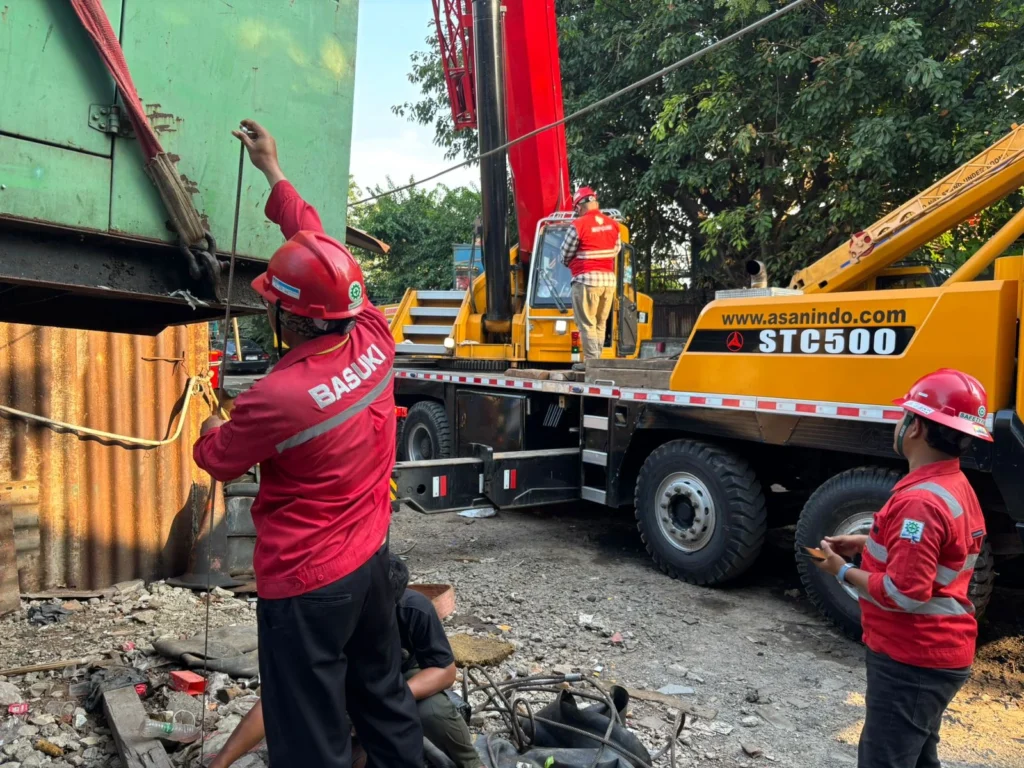
The Most Suitable Crane for Tower Erection: Mobile Crane with a Long Boom
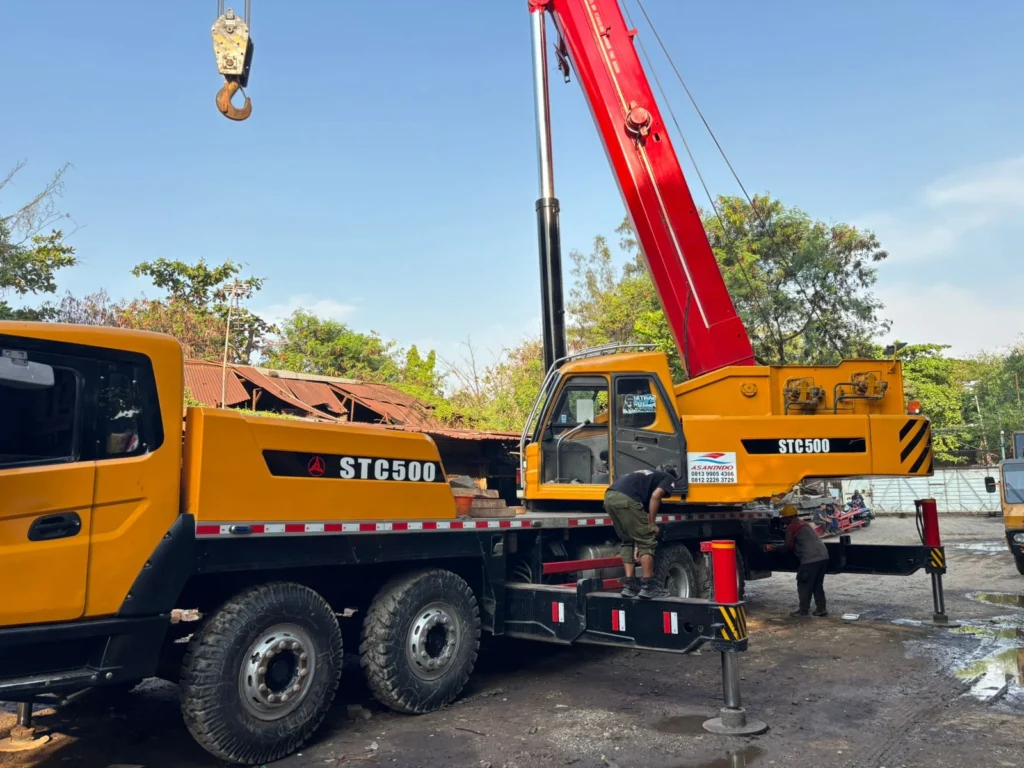
For most tower installation jobs in urban and semi-urban environments like Jabodetabek, mobile crane (truck crane) with a long boom is the most appropriate and most frequently used option.
Why is a mobile crane superior to other options for this job?
✅ Significant vertical reach without permanent installation A mobile crane with a fully extended telescopic boom can reach heights of 40–60 meters (even more with a fly jib) without needing to be permanently installed like a tower crane. This is highly efficient for tower installation work, which is generally completed within a few days to a few weeks.
Excellent mobility Mobile cranes can be driven directly to the project site, positioned precisely, and moved to another location when the work is completed. For tower installation projects that frequently change locations (like a BTS contractor installing dozens of sites in a year), this mobility is invaluable.
✅ Relatively quick setup Unlike tower cranes that take days to erect and dismantle, mobile cranes can be set up in 1–2 hours and are ready to work. For tower projects with tight schedules, this is a very significant advantage.
✅ No special foundation required A mobile crane stands on its own outriggers and does not require a permanent foundation at the site, unlike a tower crane which needs a special concrete foundation that must be planned from the building's design.
Choosing the Right Crane Capacity for Tower Installation
Now that it's understood that a mobile crane is the most suitable option, the next question is: What capacity is needed?
It isn't as simple as “bigger is better.” A crane that is too large for a confined location can actually be problematic — it might not fit through narrow access points, the outrigger pressure could be too great for the ground or building floor, or the dimensions might be too large for maneuverability.
Here are the guidelines for selecting capacity based on tower job type:
🔹 8 Ton Mobile Crane — For Tower Work in Very Limited Areas
Suitable for:
- Installation of an antenna or lightweight component on top of a low-rise building (2-4 stories)
- Installation of repeaters or small equipment at limited heights
- Installation of small to medium-sized signage
- Work on sites with very limited access (narrow alleys, small yards)
Limitations: Shorter boom (max ~28 meters) and limited capacity. Not ideal for standard cell towers requiring higher reach.
🔹 25-Ton Mobile Crane — For Cell Tower and Medium-Sized Antenna Installation
Suitable for:
- BTS Tower with a height of 30-40 meters
- Installation of a medium-weight platform and antenna array
- Installation of telecommunications equipment on existing towers
- Installation of a medium-sized water tower
Advantages A good combination of boom reach (up to ~48 meters with the jib), adequate lifting capacity, and dimensions that are still relatively compact enough to access urban sites.
🔹 30-Ton Mobile Crane — The Best Choice for Most Tower Projects
Suitable for:
- Standard cell towers up to 50–60 meters
- Installation of a medium-scale radio transmission tower
- Installation of a large antenna structure
- Erection of the heavier tower segments
- Installation of a large water tower
Why 30 metric tons is often the top choice: The combination of a sufficiently long boom (up to ~56 meters with the jib), lifting capacity adequate for most tower components, and excellent mobility makes the 30-metric-ton crane the most commonly used unit in tower installation projects in the Greater Jakarta area.
🔹 50–55-Ton Mobile Crane — For Large Towers and Large-Scale High-Rise Construction
Suitable for:
- TV/radio transmission towers 60 meters or taller
- Installation of a large satellite dish or a very heavy antenna array
- Construction of a tower with components weighing more than the 30-metric-ton crane can lift
- Installation of a tower at a location with a working radius farther from the crane unit
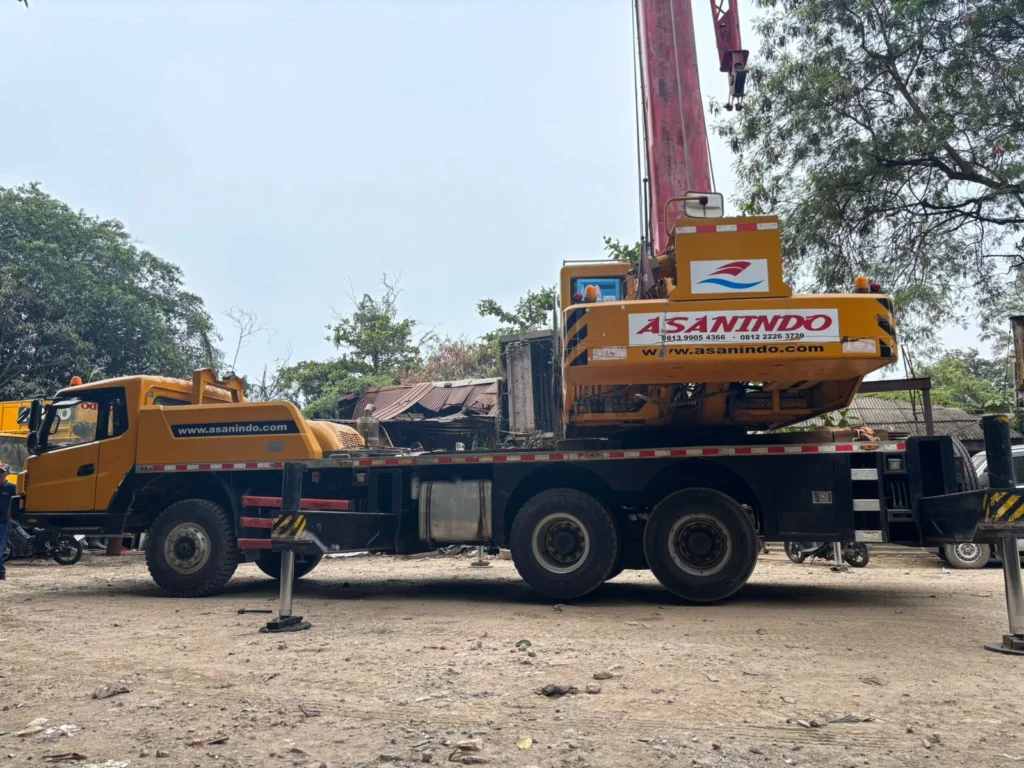
Advantages of the 55-metric-ton crane (SANY STC550C5): 45-meter boom + 16-meter fly jib = total reach of ±61 meters. This allows the crane to reach heights that smaller-capacity cranes cannot, while still maintaining significant lifting capacity.
Important Factors to Consider Before Ordering a Tower Crane
Tower installation is a task that requires thorough technical planning. Here are the factors that must be considered before determining which crane to use:
📏 Maximum Installation Height
This is the most fundamental factor. The installation height of the component highest determining the minimum boom length required. But remember: boom length and lifting height not the same — The effective lifting height depends on the boom angle and working radius. Always verify the actual lifting height the crane can reach at the required radius.
⚖️ Heaviest Component Weight
The heaviest tower component determines the minimum crane capacity. Don't forget to add the weight of rigging equipment (slings, shackles) to the total load.
Available Working Radius
Where can the crane stand relative to the mounting point? The further the horizontal distance of the crane from the lifting point (larger radius), the smaller the effective capacity available at the same height.
🗺️ Access Location
Is there a wide enough road for a crane to enter? What is the overhead clearance (power lines, awnings, other obstructions)?
🏗️ Soil or Floor Conditions
Tower on top of a building? Cranes might have to stand on the street or courtyard below the building — the ground conditions and load capacity of the street must be taken into account for outrigger cranes.
💨 Wind Condition
Work at height is greatly affected by wind speed. Planning must include procedures for work stoppage if the wind exceeds safe limits.
Specific Safety Procedures for Tower Installation
Working at height with cranes requires an additional layer of safety on top of standard OHS procedures. Here are some things we always implement in tower installation projects:
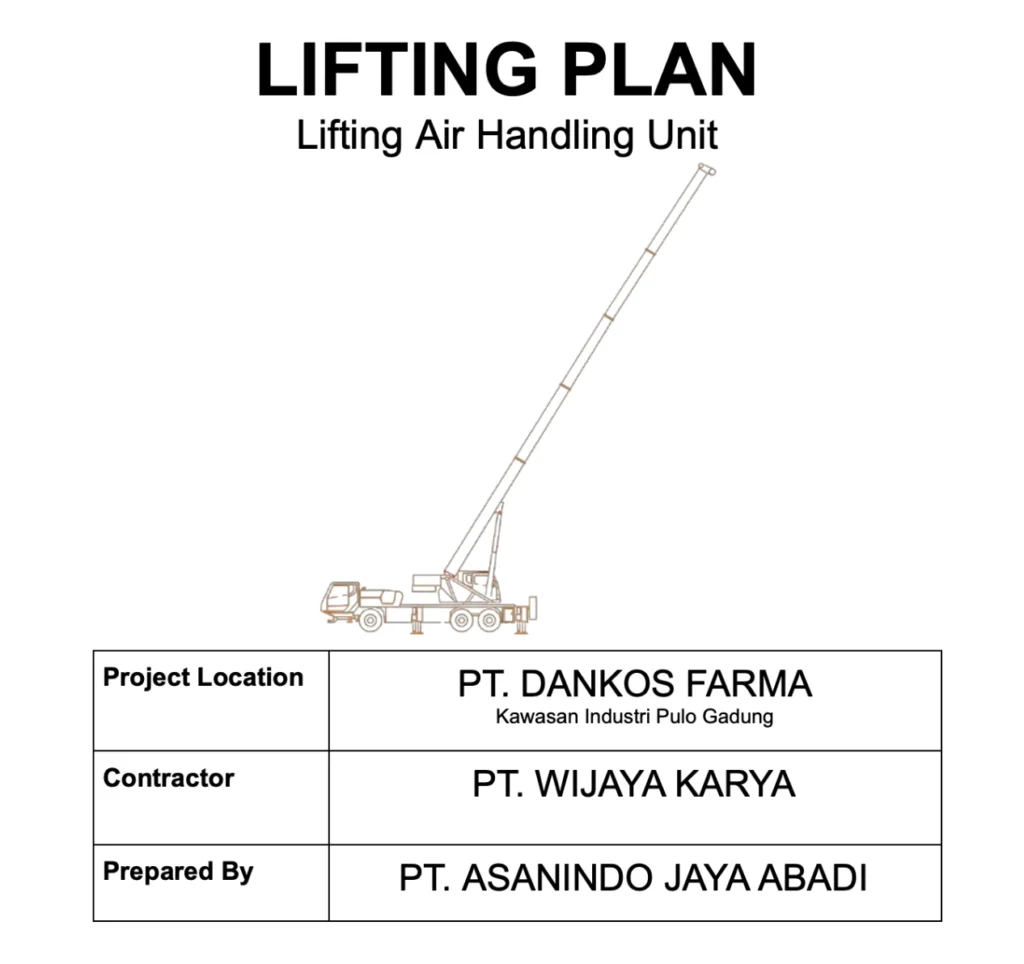
🛡️ Extremely Detailed Lifting Plan For work at heights, the lifting plan must include: the sequence for installing components, the crane’s position for each stage, the effective capacity for each configuration, communication procedures between the crane operator and workers at heights, an exclusive zone beneath the work area, and emergency procedures.
🛡️ Intensive Coordination Between Crane and High-Altitude Team Unlike lifting loads at ground level, when loads are lifted to heights of tens of meters, the crane operator's visibility becomes very limited. Communication using radios (not just hand signals) is highly recommended to ensure proper coordination between the crane operator, the rigger below, and the workers receiving components at height.
🛡️ Wind Risk Management Loads suspended at heights of 40-60 meters are highly susceptible to wind forces, which can cause dangerous swings. Tag lines controlled from below are critical tools, and operations must be halted if wind speeds exceed the safe limits established in the lifting plan.
🛡️ Strictly Restricted Zone The area beneath a lifted load must be completely clear of unauthorized personnel—this is even more critical for work at height as the consequences of a load falling from a height are far more serious.
Case Study: How to Choose a Crane for a Standard BTS Tower?
Let's use a real-world scenario as an example:
Project specifications:
- Type: 4-leg self-supporting BTS tower
- Total tower height: 42 meters
- Heaviest component: Lower leg segment of the tower, weighing ±2.5 tons per segment
- Top equipment: Antenna array ±800 kg
- Location: A 20×30-meter vacant lot along the roadside
- Distance from the edge of the road to the center tower (estimated crane radius): ±10–12 meters
Analysis:
- Maximum lifting height required: ±43–45 meters (tower + slight clearance)
- Minimum capacity required at a radius of 10-12 meters: ±3-4 tons (with safety factor)
- Recommended crane types: 25 Ton or 30 Ton Mobile Crane
Why a 25-ton crane is sufficient: A boom + jib crane with a 25-ton capacity can reach approximately 48 meters, and its effective capacity at a radius of 10–12 meters is generally sufficient for lifting standard BTS tower components.
Why is a 30-ton crane often recommended: A larger capacity margin provides a safer “margin of safety” in case a component is heavier than expected, or if the crane needs to be positioned slightly farther away than planned. For a relatively small difference in cost, a 30-metric-ton crane offers invaluable peace of mind when working at heights.
📞 Do you have a tower project with different specifications? Tell our team about your project details — we will analyze them and recommend the most suitable and efficient unit.
FAQ: Frequently Asked Questions About Cranes for Tower Erection
How long does it take to install one BTS tower using a crane? It varies greatly depending on the tower height, number of segments, and antenna configuration complexity. For a simple 30-40 meter BTS tower, the installation process using a crane can be completed in 1-2 shifts (7-14 working hours). Taller or more complex towers may require 2-4 working days.
Can a mobile crane be used on top of a building for antenna installation? A: A mobile crane operates at ground level—it does not go up onto the building. To install an antenna on top of a building, the crane is positioned on the street or in an area below the building and lifts the components using its extended boom to the required height. This is why it’s crucial to calculate the boom length and effective lifting height before ordering the unit.
Q: Can a single crane handle the entire process of installing a BTS tower from start to finish? Typically, one mobile crane with the right capacity and boom can handle the entire installation process, from the foundation to the highest components. However, for very tall towers or those requiring two installation stages with different configurations, it's sometimes necessary to reposition the crane or add a jib at a certain stage.
Q: Are there special permit requirements for using a roadside crane to install a tower? For crane use on public roads that requires partial traffic lane closures, coordination with the Department of Transportation and local police is necessary. For locations on private property (without using the roadway), permit requirements are simpler. Our team can provide guidance on this matter.
Q: Is Rentalcranejabodetabek.com experienced in tower installation projects? Yes. We have experience in various types of projects requiring high-altitude lifting, including the installation of tall structures. Our team of operators and riggers understands the specific challenges of working at heights and the necessary safety procedures.
Contact Us — Free Crane Consultation for Towers
Tower installation projects require the right crane, an experienced operator, and careful planning. Rentalcranejabodetabek.com ready to support your project with units that meet specifications, SIO-certified operators, and free site survey services.
📞 WhatsApp / Phone (Fast Respon 24 Hours):
0813-8080-1729
(Davin Aubade)
🌐 Website: www.rentalcranejabodetabek.com
“Provide your tower specifications—height, component weight, and site conditions. Our team will recommend the most suitable crane and provide a transparent cost estimate.”
Related Articles & Services
- 🔗 8 Ton Crane Rental — Rp 3,500,000/shift, for light antennas & narrow areas
- 🔗 Crane Rental 25 Ton — Rp 4,800,000/shift, for medium BTS tower
- 🔗 Crane Rental 30 Ton — Rp 5,500,000/shift, the best choice for the majority of towers
- 🔗 Crane Rental 55 Ton SANY STC550C5 — IDR 8,600,000/shift, for large towers
- 🔗 Mobile Crane Capacity Guide — how to calculate the correct tonnage
- 🔗 7 Types of Cranes and Their Functions — all types of cranes explained
- 🔗 24-Hour Mobile Crane Rental Near You — Quick response for urgent needs
- 🔗 Crane Rental Price Per Shift — full rate 2026
- 🔗 Contact Us — consultation and quote